Your Knowledge Graph Doesn't Have an Opinion

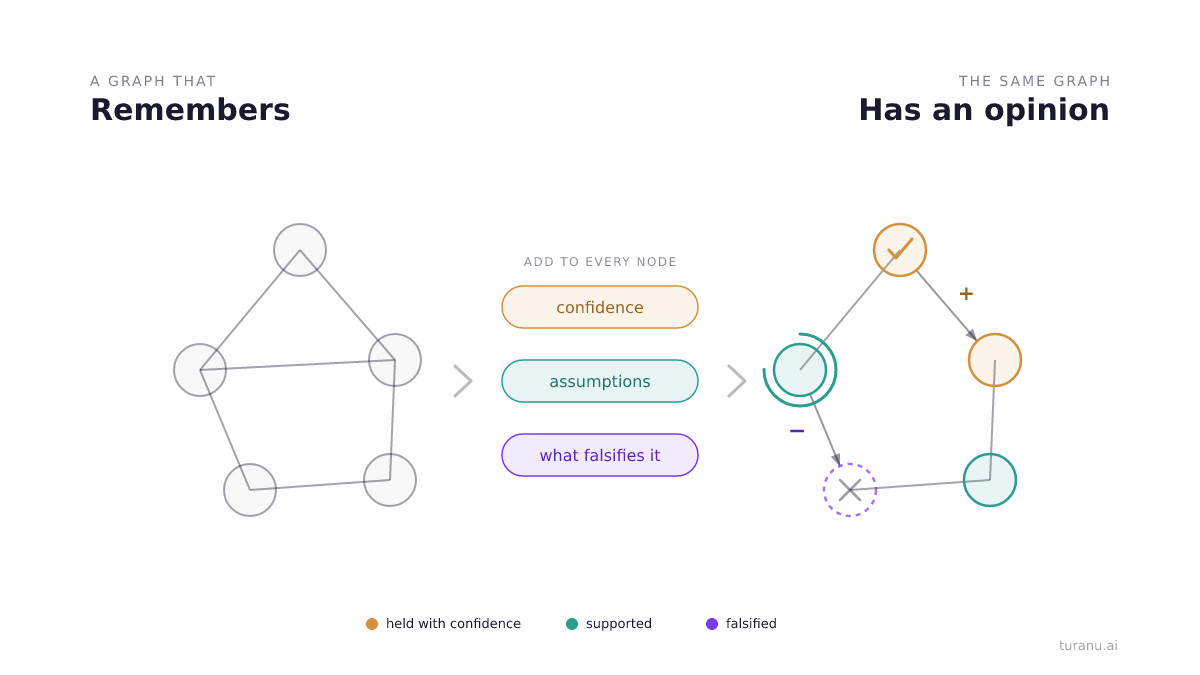
Most knowledge tools remember what you read. Almost none of them keep a track record of whether you were right.
You can retrieve any fact you have ever filed. You cannot retrieve whether you were right about it. That second gap is the expensive one, and most knowledge systems are built so you never have to look at it.
A knowledge graph is engineered to remember and to connect. Its smallest unit is a fact: an entity, a relationship, a source. Collect enough of them and you get something genuinely powerful at recall. Ask it anything and it returns what you stored. What it returns is neutral. It does not tell you how confident you were when you saved it, what that belief depended on, or whether the world has since proven you wrong. It is a very good librarian, and a librarian holds no view on whether the books are true.
This is not a defect in any one tool; it is the design center of the whole category. Knowledge products optimize capture and retrieval because those parts scale cleanly and demo well. So the system grows more comprehensive every week and no more opinionated. You accumulate a near-perfect memory of your inputs and no record at all of your judgment.
The hard part moved
That tradeoff used to be acceptable, because forming the analysis was the hard part. It is not the hard part anymore. A capable model will produce a competent argument on almost any topic in seconds, then produce the opposite argument just as quickly. The cost of generating a view has collapsed toward zero. What has not gotten cheaper is knowing which view to trust, including your own. The constraint moved from producing analysis to verifying it, and a knowledge graph sits on the wrong side of that line. It can hold a thousand well-sourced claims and still cannot tell you which ones have earned your belief.
What it takes to give it a view
Giving a knowledge system an opinion means changing what it stores. Instead of filing a fact, you file a position: a claim, the confidence you actually hold it at, the assumptions underneath it, and the specific thing that would prove it wrong. A position costs only slightly more to record than a note, and it behaves completely differently over time. It can be stress-tested. It can be set against a position you took six months earlier and forced to reconcile. When one of its assumptions breaks, the system can flag which of your conclusions just became unsafe.

The piece that turns a richer note into an actual opinion is the part almost nothing in the market builds, because it is unglamorous and it scales badly: a loop that checks your positions against what happened. Record what would falsify a belief and you can later confirm whether it did. Record how sure you were and you can later score whether that confidence was warranted. Run this across hundreds of positions and the system stops being a record of what you thought and becomes a measure of how well you think.
That is the asset a knowledge graph cannot hand you and the one worth building toward: a track record of your own judgment. It shows where your instincts have been sharp and where they have been reliably off, with the receipts attached.
Why a decision-maker should care
The value is concrete for anyone who decides for a living. Most executives and product leaders run a standing portfolio of live bets about the market, the roadmap, and where to place the next investment. Most people manage that portfolio from memory, which means they manage it from a flattering edit of memory. You recall the calls that landed. You quietly drop the ones that did not, and you carry the same uncorrected biases into the next decision because nothing ever priced them. A system that holds your positions and reconciles them against outcomes deletes the flattering edit. It tells you, with evidence, which of your views have earned the conviction you keep extending them.
It also compounds in a way a document pile never will. A larger archive is just a larger archive. A judgment record gets more valuable with every position that resolves, because the scoring gets more honest and the patterns get easier to see. Given a few years it becomes the most useful thing you own: a calibrated map of your own reliability, sorted by the kinds of decisions you actually make.
The test for a knowledge system is shifting because of this. The old questions were how much it holds and how fast it returns. Those are table stakes now, and they are commoditizing quickly as more tools staple a graph to a model. The question that will decide which systems matter is whether yours has a point of view and whether it gets measurably better at being right. Build for recall and you get a better library. Build for judgment and you get a system that makes you a better decision-maker the longer it runs; over the next decade, only one of those is worth compounding.
#AIStrategy #DecisionIntelligence #KnowledgeManagement #ProductLeadership #AI