The Two Capital Loops Powering the AI Boom

How OpenAI rewired the economics of compute through two feedback loops
I love seeing systems loops in action.
Feedback mechanisms reveal how complex systems actually work. And right now, we're witnessing two of the most elegant — and opposite — capital loops ever engineered in tech
In the span of two weeks, OpenAI has orchestrated deals up to $200 billion with chip giants Nvidia and AMD. But here's what everyone is missing: these aren't just procurement contracts. They're two fundamentally different system architectures with radically different feedback loops.
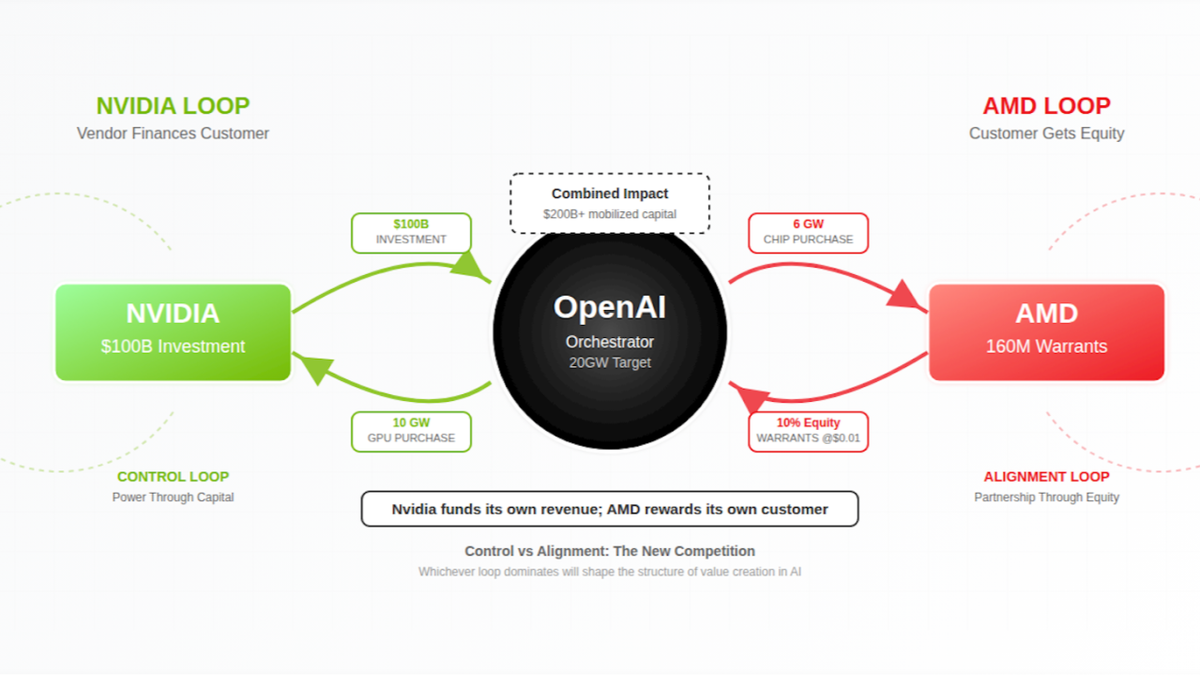
The diagram below captures how OpenAI orchestrated two opposite capital loops with Nvidia and AMD. (See infographic: "The Two Capital Loops Powering the AI Boom.")
One optimizes for control. The other for alignment. Both reveal how the AI economy will actually work.
The Setup: OpenAI's Impossible Math Problem
OpenAI faces a challenging reality: projected AGI-scale systems may eventually require at least 16 to 20 gigawatts of computing power, but current infrastructure is far below that level. In 2025, OpenAI is on track to generate about $13 billion in revenue, with annual cash burn and compute costs closer to $8–9 billion. The math doesn't work — unless you redesign the system dynamics itself.
Enter two deals that create entirely different feedback loops in the infrastructure finance system.
Loop #1: Nvidia's Vendor-Financed Control
Nvidia invests up to $100B in OpenAI — and OpenAI spends it right back on Nvidia chips.
This is a classic reinforcing loop with a twist. Nvidia essentially funds its own revenue, creating a closed financial circuit where capital flows from Nvidia → OpenAI → back to Nvidia. From a systems perspective, it's a self-reinforcing cycle that strengthens with each iteration.
What Nvidia Gets:
- Guaranteed demand (they're funding it themselves)
- Ecosystem lock-in (OpenAI becomes more dependent)
- Revenue certainty (the money always comes home)
- Market signaling ("OpenAI chose us")
This is a positive feedback loop that concentrates power. Each cycle increases dependency, which increases Nvidia's leverage, which enables more aggressive terms, which further increases dependency. Classic lock-in dynamics.
The Philosophy: Control through capital dependency. Nvidia isn't selling chips — it's selling membership in an exclusive club where admission is paid with your autonomy.
Loop #2: AMD's Equity-Aligned Partnership
OpenAI buys 6 GW of AMD GPUs — and AMD rewards it with penny-priced warrants worth up to 10% of the company.
This creates an entirely different system dynamic. Instead of AMD funding OpenAI, OpenAI funds AMD — but receives massive equity upside if the partnership succeeds. It's a balancing loop with shared feedback mechanisms.
What AMD Gets:
- Immediate revenue (tens of billions over 5 years)
- No cash outlay (OpenAI pays upfront)
- A committed champion (OpenAI now owns potential 10% stake)
- Market credibility (breaking Nvidia's monopoly)
This is a mutually reinforcing loop where both parties' incentives align. OpenAI's success drives AMD adoption, which increases AMD's stock value, which benefits OpenAI's warrant position, which incentivizes more AMD deployment. It's symbiotic rather than parasitic.
The Philosophy: Growth through aligned incentives. AMD isn't buying a customer — it's creating a partner with skin in the game.
Nvidia funds its own revenue; AMD rewards its own customer.

The Strategic Genius of OpenAI's Position
From a systems thinking perspective, here's what Sam Altman has actually built: a portfolio of loops with different characteristics.
- With Nvidia: OpenAI gets unlimited capital but accepts a dependency loop
- With AMD: OpenAI maintains independence while creating an alignment loop
- Combined: OpenAI has secured 16 gigawatts of compute, $100B+ in financing, and equity in a major chip maker
OpenAI has become the central node in a multi-loop system — simultaneously customer, partner, and kingmaker. They're not just participating in the system; they're redesigning it.
Three System Dynamics Nobody's Talking About
1. The Death of Linear Supply Chains
When your suppliers finance you (Nvidia) or give you equity (AMD), the traditional linear buyer-supplier relationship becomes a circular system. We're entering an era of circular capital flows where money, compute, and equity form interconnected loops rather than chains.
2. Compute as a State Variable
Both deals treat GPUs not as products but as system state variables that can be manipulated through different mechanisms. Nvidia couples through debt; AMD through equity. The real innovation isn't in silicon — it's in system design.
3. The Emergence of Loop Competition
AMD just proved you can compete with Nvidia not by building better chips (though that helps), but by building better loops. By creating alignment dynamics rather than control dynamics, they've introduced a new competitive vector that Intel, Broadcom, and others may copy. The game just went from one dimension to two.
The Bigger Picture: Capital Design as System Architecture
These deals reveal a profound truth: in the AI era, how you architect capital flows is as important as how you architect neural networks.
Nvidia's loop is a centralizing force — it concentrates power and creates dependency cascades. AMD's loop is a distributed force — it aligns interests and creates resilience through redundancy.
Both are betting that compute scarcity will define the next decade. But they're making opposite bets on which system dynamics will prevail: control hierarchies or alignment networks.
The Bottom Line
OpenAI has effectively become a meta-loop operator — orchestrating multiple feedback mechanisms across the chip industry. They're collecting investments from one loop while collecting equity from another, creating a diversified portfolio of system dynamics.
For those of us trained in systems thinking, these deals offer a preview of the new rules:
- Capital and compute are becoming interchangeable state variables
- Equity alignment creates more robust loops than debt dependency
- The winners won't just have the best technology — they'll have the best system architecture
The AI race has evolved from a contest of chips to a contest of systems. And OpenAI just demonstrated mastery of both positive and negative feedback loops simultaneously.
As we learned at MIT: the structure of the system determines its behavior. OpenAI just restructured the entire game.
Whichever loop dominates — control or alignment — will shape not just the GPU market, but the structure of value creation in AI itself.
Are we watching the birth of a new class of economic feedback loops — or the early signs of a system near criticality?