
English Has No Keyword for Must

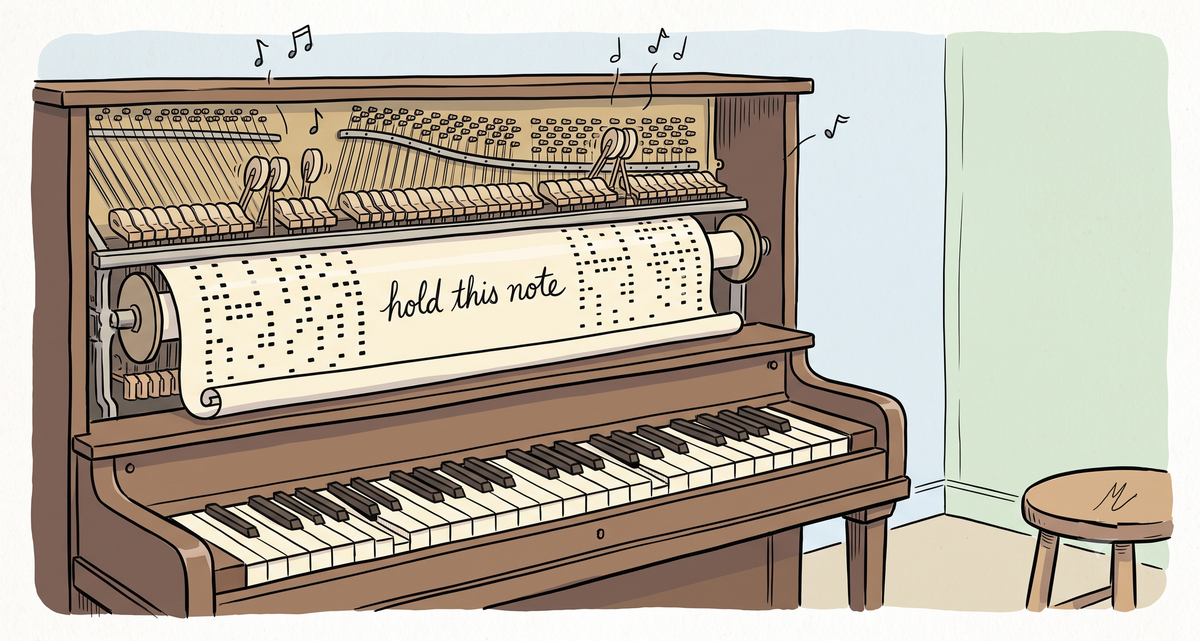
Few would ship a compiler that re-parsed your source differently on every run. That is what a prompt is.
"The hottest new programming language is English." Karpathy is right, and the line has been carrying more weight than it was built for. Programming languages are compiled or interpreted, and the slogan does not say which. English turns out to be both, depending on where you put it, and the two behave nothing alike.
Describe a feature, an agent writes the code, and the artifact runs the same way every time. English was the source and something deterministic came out the other side. That works, and it is most of why agents are useful.
Write a sequence of steps into a markdown file and hand it to a model to perform on every run, and nothing was compiled. The document is the runtime, re-interpreted on each execution by a system whose defining property is that it decides what you meant.
I found this the way most things get found, which is by having it fail quietly. A step that existed only as an instruction in a document did not run. Not misjudged, not performed badly. Absent, on consecutive production runs, and nothing reported it. Skipping a sentence is not an exception, so there was no stack trace for a line that was never acted on. In the same system there were controls that were documented, referenced elsewhere, and parsed by nothing whatsoever. They read like features. They were descriptions of features.
The line worth drawing is between judgement and sequence. Is this test adequate, does this change satisfy the goal, what should be built next. Those want latitude, and a different answer on a rerun is the value rather than the defect. Whether the checker ran, whether the budget halted, whether step five happened at all. A different answer there is a bug. The first belongs in English. The second does not belong.
The objection is that models keep improving, and they do. This is not a capability limit. A probabilistic interpreter has no notion of obligation, so writing MUST in capitals does not create a requirement, it raises a prior. Improvement moves something like 97% to 99%, which is fine for a step you are watching and worthless for a step between two checkpoints in an unattended run. A more capable model is arguably likelier to notice a step looks redundant and compress it.
Systems built this way end up with sentences that must be true on every single execution. Most of them are held up by nothing sturdier than the hope that someone reads them.
#AgenticAI #AIEngineering #LLMOps #ProductLeadership #SystemDesign